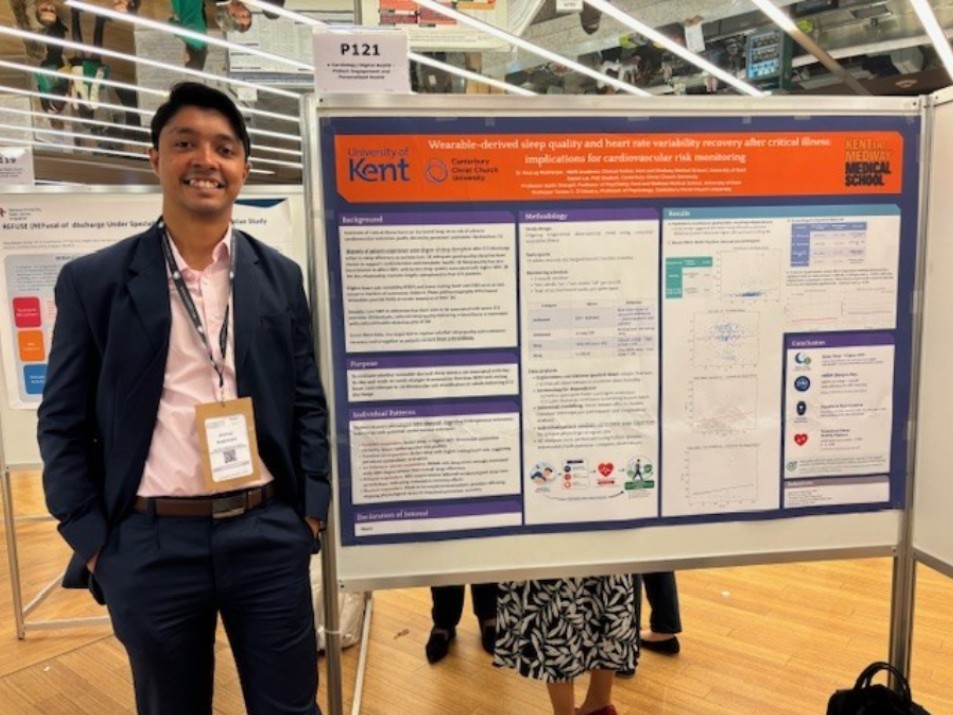
Dr Anurup Mukherjee, a founding member of the KMMS Academic Clinical Fellow Programme and Internal Medicine Trainee at Maidstone and Tunbridge Wells (MTW) NHS Trust, presented a poster, “Wearable-derived sleep quality and heart rate variability recovery after critical illness: implications for cardiovascular risk monitoring”, at the European Society of Cardiology (ESC) Preventive Cardiology 2026 Conference, held in Ljubljana, Slovenia.
Dr Mukherjee’s research aims to develop clinically useful tools for remote monitoring and early intervention and to establish the feasibility of using wearable technology as a scalable, non-invasive way of monitoring health in high-risk populations following critical illness. These patients are known to have an increased risk of deterioration, particularly from cardiovascular causes, but currently receive limited physiological monitoring once discharged. Wearables could provide a way to continuously track recovery at home and help identify individuals who may be at higher risk earlier.
Dr Mukherjee is running a longitudinal observational study involving patients recently discharged from intensive care (ICU). The team including KMMS faculty and staff at MTW and the East Kent Hospitals NHS Trust used wearable devices (Fitbit) to monitor patient’s sleep quality (including sleep efficiency and Non-Rapid eye movement (NREM) sleep), along with autonomic markers such as heart rate variability (HRV) and resting heart rate over several weeks. The analysis focused on understanding how these physiological parameters change over time within individuals, and how sleep and autonomic recovery interact during the post-ICU recovery period.
Early findings suggest that sleep quality is closely linked to autonomic function, and this opens up potential areas for intervention. For example, improving sleep, supporting autonomic recovery, or targeting factors such as fatigue and physical activity may have interconnected effects that could enhance overall recovery. Understanding these relationships could help guide more personalised rehabilitation strategies after ICU discharge and help improve healthcare outcomes for patients.
Dr Mukherjee, who has been enabled to do this research as part of his Academic Clinical Fellowship (ACF) with KMMS, said: “I intended to undertake this project as an initial proof-of-concept and now will work with the team to expand it to a larger cohort to validate these findings. In the future, I will also explore more advanced analytical approaches, including machine learning, to better characterise recovery patterns and identify patients at higher risk.”
It has been great to be enabled to do this research as part of my Academic Clinical Fellowship (ACF). It has been a fantastic opportunity to combine clinical training with research in digital health. It has allowed me to work on innovative projects using technologies such as wearables and AI, and to explore how these can improve patient care and accessibility to healthcare.
“The role has also enabled me to build a strong network, gain deeper insight into the field, and engage in research alongside clinical training. Overall, the fellowship has significantly strengthened my portfolio and helped me become a more well-rounded clinician with a strong foundation in both research and clinical practice.”
Professor Jim Ang, KMMS, said: “I think poster presentations are an important part of early-career academic development. They give researchers the opportunity to discuss emerging ideas, get feedback from experts in the field, and often help shape the future direction of their careers.
“Anurup’s work is particularly exciting because it sits at the intersection of wearable sensing, multimodal patient data, and AI-driven medicine, areas which I think will become increasingly important in supporting recovery following critical illness.”
KMMS is looking forward to welcoming our third cohort of ACFs later this summer. These posts, won through national competition and funded by the National Institute for Health and Care Research (NIHR), enable doctors in the early stages of their specialty training to combine their clinical training with academic research. It is a key element of the KMMS vision to support research throughout a doctor’s career, from their first year of study onwards.