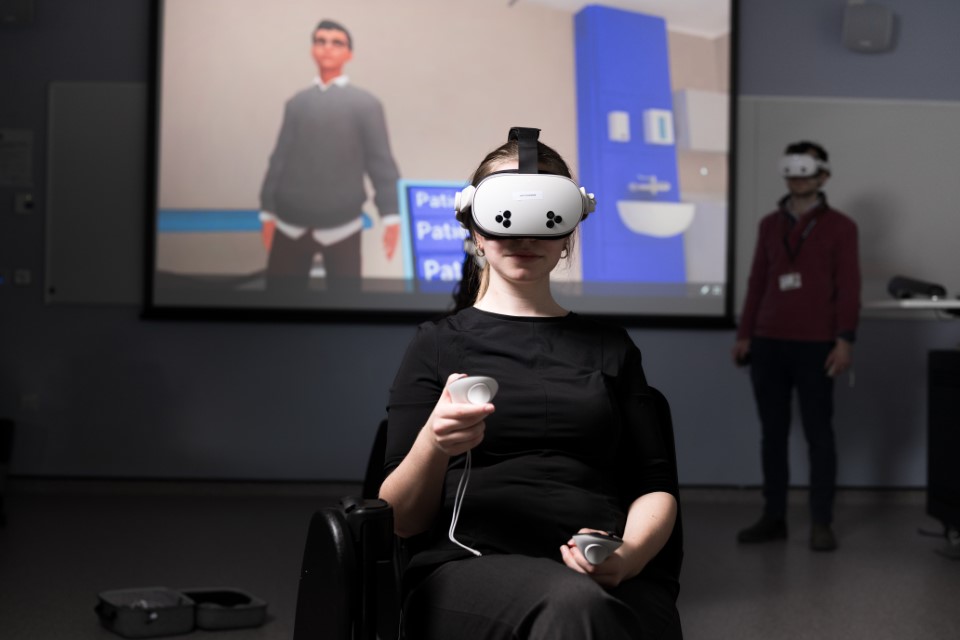
Researchers at the University of Kent and Kent and Medway medical school have published a paper, exploring whether recent studies show that virtual reality “real world” tasks could be used to assess early changes associated with Alzheimer’s disease as an alternative/addition to the paper-based abstract tasks currently used.
The paper, The Use of Fully Immersive Virtual Reality for Screening Neurodegenerative Diseases authored by Zhao Liu, Daniele Soria, Daniel Jie Lai, Jinbao Zhang, Sukhi Shergill, and Chee Siang (Jim) Ang is published in Alzheimer’s & Dementia: Diagnosis, Assessment & Disease Monitoring.
In this study, the team explores how fully immersive VR environments can be used to assess cognitive performance and behavioural responses that correlate with early neurodegenerative changes. The participants engage in complex, real-world-like activities ranging from making a cup of tea and navigating a big city to challenges that challenge memory, spatial awareness, executive function, and functional mobility. At the moment the assessment has an accuracy rate of between 87 – 100 %.
The research highlights the exciting potential of digital health assessments and cutting-edge technologies to enhance the early identification and monitoring of neurodegenerative diseases, ultimately facilitating timely intervention and improved patient outcomes.
Professor Jim Ang, Professor of Human-Computer Interaction Kent and Medway Medical School, says:
It was important to do this review now, as things in the sphere of virtual reality and sensor technologies are moving quickly. It is great to see that the number of studies around the world in this area is growing, leading us towards a future where sensor-enhanced VR could be used to detect cognitive abilities in patients with a high degree of accuracy
Professor Sukhi Shergill, Director of Research at KMMS says:
We are beginning to understand the power of VR as a diagnostic tool and to explore the participant experience and running clinical trials to test both the efficacy of the tests and to scope the requirements for VR headsets of the future.
Wouldn’t it be amazing to develop VR tests that meaningfully indicate how people with memory complaints cope with real-life tasks and whether they are improving these skills because of treatments they are taking – watch this space!
Access the full article: http://dx.doi.org/10.1002/dad2.70244