
Information for Prospective Academic Clinical Fellows (ACFs) - Kent and Medway Medical School

Kent and Medway Medical School

Information for Prospective Academic Clinical Fellows (ACFs)

Integrated Academic Training

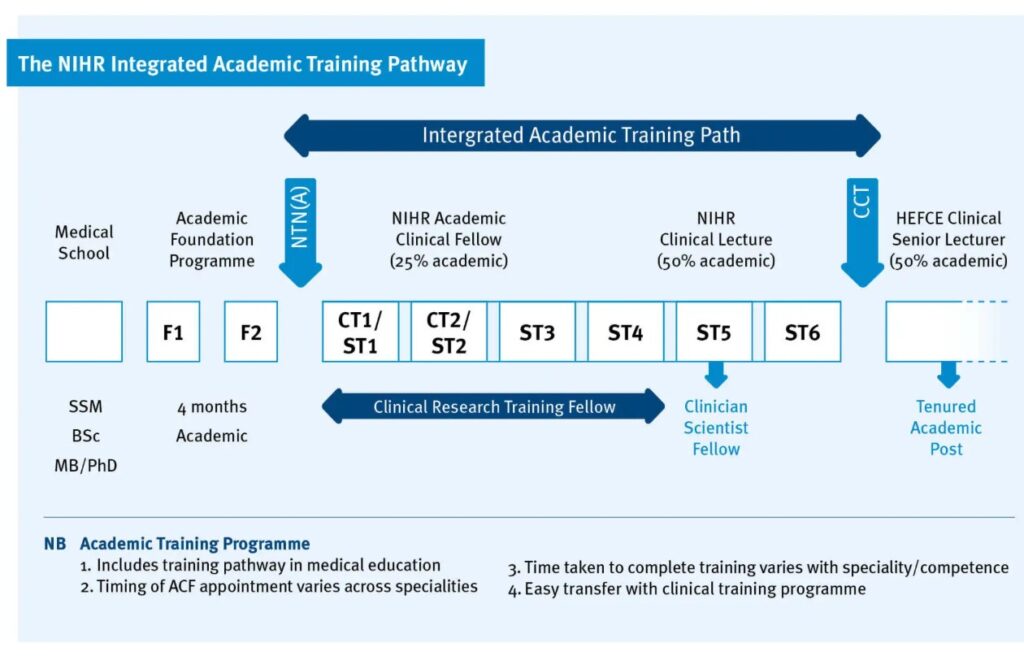
Clinical academic training schemes enable doctors in medical training programmes to simultaneously carry out research alongside clinical academics or University-based academics. The aim is to provide clearly structured research and academic opportunities at various stages during clinical training. Doctors have a protected proportion of time to focus on research or educational projects and to develop research methodologies and other academic skills. A fundamental aim is to complete a PhD and to subsequently progress as a senior clinical academic.

Clinical academic training opportunities at Kent and Medway Medical School (KMMS) are funded by the National Institute for Health and Care Research (NIHR) through the Integrated Academic Training Pathway (IAT). The NIHR IAT pathway supports academic clinical career opportunities at the Academic Clinical Fellow (ACF) and Clinical Lecturer (CL) levels, with opportunities at ACF level currently available through KMMS.
Recruitment

Recruitment for all ACF opportunities on the Integrated Academic Training programme is conducted via NHS England regions and managed through Oriel, the national NHS online recruitment system. Recruitment to ACF posts at KMMS is coordinated by the London NHSE London and Kent, Surrey and Sussex (LaKSS) Recruitment team.

Recruitment windows usually open in October for posts starting in the following September. ACF opportunities at KMMS are available in different specialties each year. If shortlisted, applicants will be required to attend an integrated academic interview, consisting of both academic and clinical questions and assessors.

If you require clinical benchmarking, you will be required to complete and submit both an academic application form and the associated clinical application form for the specialty in which you require clinical benchmarking. Once the clinical benchmarking interview has been completed and scores confirmed, your ACF appointing region will be notified of the outcome so they can confirm any offer made.

ACF posts are designed to include 25% time learning and carrying out academic research,  combined with 75% time in clinical training. How this split is managed should be decided between you, your academic supervisor and your clinical supervisor. The posts are for a fixed term of 3 years (or 4 years if in General Practice). The ACF awards use clinical training opportunities on current GMC approved training programmes. KMMS works with Trusts across Kent alongside our academic colleagues within the University of Kent and Canterbury Christ Church University. Day-to-day management is by clinical and academic supervisors and training programme directors at your host Trust.

NIHR IAT ACF Post Funding

ACF posts are 100% NIHR-funded (excluding on-calls and banding) for three years. The rotating trust for clinical training is the employing body and an honorary contract is set up with the medical school.  Details of all ACF appointments, recruited on our behalf by NHS England, are shared with the relevant trust HR Teams via the NHSE trust portal once they have been finalised.

All ACF trainees in post will have their salaries funded at 100% for the duration of the academic award – whether working in the clinical or academic component of their academic programme.

Contract

KMMS ACFs will have a contract with an NHS Trust and an honorary contract with the University of Kent. The CATO team will organise your honorary contract, which will enable ACFs to access IT accounts and library resources within both the University of Kent and Canterbury Christ Church University.

Clinical Academic trainees will also be required to complete other routine HR new starter and induction formalities. You will be invited to attend an induction session at KMMS, at the Pears Building on the University of Kent campus, Canterbury.

Academic supervisor/research project supervisor

Every ACF/CL will have a named academic supervisor to support the academic/research component of their programme. Academic trainees should work closely with their supervisors, meeting them regularly to agree on project aims, discuss progress and plan what further skills and training might be required.

Clinical supervisor

For the clinical element of their academic programmes, trainees will have a clinical supervisor who is responsible for overseeing their clinical work for a specified placement in a clinical environment. These supervisors can also provide advice and support to academic trainees, but usually in the context of their clinical training.‌

Organising research blocks

As soon as they have been appointed, ACFs should make contact with the Clinical Lead/Training Programme Director and Academic Training Lead for their specialty to discuss and agree how the 25% research time will be organised. If you have any difficulties in getting this time agreed/honoured within your Trust, you should contact CATO.

Research Training

KMMS ACFs have access to the Kings College London (KCL) PGCert in Applied Research Methods. This bespoke PGCert develops trainees’ depth of knowledge, technical and transferable skills in translational research and evidence-based healthcare. It also provides an opportunity to network with other ACFs. The PGCert is funded as part of the NIHR IAT Programme.